Monday, August 20, 2007

Stone age chewing gum

Stone age chewing gum
http://www.boingboing.net/2007/08/20/stone_age_chewing_gu.html


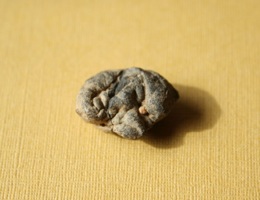
Las month, student Sarah Pickin found a piece of "Neolithic chewing gum" on an archaeological dig in Oulu, Finland. The gum, a hunk of birch bark, was likely chewed 5,000 or 6,000 years ago. From the Associated Press:

Kuvat Purupihka"Most likely the lump was used as an antique kind of chewing gum," said Sami Viljamaa, an archaeologist who led the dig near Oulu, some 380 miles north of the capital, Helsinki. "But its main purpose was to fix things..."

The ancient Finnish habit of chewing gum surged in the 1980s when Finnish scientists discovered that gum containing xylitol, a natural sweetener found in plant tissue including birch trees, prevents tooth decay.

Link to Washington Post, Link to Kierikki Excavation press release

Tuesday, August 14, 2007

Shopping & Roller coasting at the same time

This has to be the ultimate stoner muncher ride I have ever seen, almost makes me want eto smoke and ride and munch my way around the store, of course if you miss something you have to go all the way around the store. Now lets see if they can set one up in a Walmart :-) LOL link at bottom of article -gregor
http://www.boingboing.net/2007/08/13/grocery_storeride_pu.html


A grocery store in Shenyang, China, has installed a dark-ride-style ride-system that weaves among the shelves. Shoppers climb into the cars and ride through the store, grabbing their groceries as they go. If you miss your shelf, you have to ride through again. Of course, the store also gets to totally engineer your retail experience, taking you past impulse items at eye-level, etc. Link

Sunday, August 12, 2007

Photo tool could fix bad images

This could be a good think for a lot of folks,Good idea, for folks that thank want better shots than there skills or the situation allowes. Life is shot especiaqll on vacation, trying to get that perfect shot-gregor


Photo tool could fix bad images

By Mark Ward
Technology correspondent, BBC News website, San Diego


This is the original image with a roof spoiling the view...
Digital photographers could soon be able to erase unwanted elements in photos by using tools that scan for similar images in online libraries.

Research teams have developed an algorithm that uses sites like Flickr to help discover light sources, camera position and composition in a photo.


Step One
Using this data the tools then search for objects, such as landscapes or cars, that match the original.

The teams aim to create image libraries that anyone can use to edit snaps.


Stage two
Stage one: The roof is isolated and the algorithm searches for similar scenes

James Hays and Alexei Efros from Carnegie Mellon University have developed an algorithm to help people who want to remove bits of photographs.

The parts being removed could be unsightly lorries in the snaps of the rural idyll where they took a holiday or even an old boyfriend or girlfriend they want to rub out from a photograph.

To find suitable matching elements, the research duo's algorithm looks through a database of 2.3 million images culled from Flickr.

"We search for other scenes that share as closely as possible the same semantic scene data," said Mr Hays, who has been showing off the project at the computer graphics conference Siggraph, in San Diego.

In this sense "semantic" means composition. So a snap of a lake in the foreground, hills in a band in the middle and sunset above has, as far as the algorithm is concerned, very different "semantics" to one of a city with a river running through it.


Stage three
Stage two: It compares photos online to find a matching scene

The broad-based analysis cuts out more than 99.9% of the images in the database, said Mr Hays. The algorithm then picks the closest 200 for further analysis.

Next the algorithm searches the 200 to see if they have elements, such as hillsides or even buildings, the right size and colours for the hole to be filled.

The useful parts of the 20 best scenes are then cropped, added to the image being edited so the best fit can be chosen.

Early tests of the algorithm show that only 30% of the images altered with it could be spotted, said Mr Hays.

The other approach aims to use net-based image libraries to create a clip-art of objects that, once inserted into a photograph, look convincing.


Stage three: The finished picture has the roof removed and boats in a bay added

"We want to generate objects of high realism while keeping the ease of use of a clip art library," said Jean-Francois Lalonde of Carnegie Mellon University who led the research.

To generate its clip art for photographs the team has drawn on the net's Label Me library of images which has many objects, such as people, trees and cars, cut out and tagged by its users.

The challenge, said Mr Lalonde, was working out which images in the Label Me database will be useful and convincing when inserted into photographs.

The algorithm developed by Mr Lalonde and his colleagues at Carnegie Mellon and Microsoft Research analyses scenes to find out the orientation of objects and the sources of light in a scene.

"We use the height of the people in the image to estimate the height of the camera used to take the picture," he said.

The light sources in a scene are worked out by looking at the distribution of colour shades within three broad regions, ground, vertical planes and sky, in the image.


Step Four
With knowledge about the position, pitch and height of the camera and light sources the algorithm then looks for images in the clip art database that were taken from similar positions and with similar pixel heights.

The group has created an interface for the database of photo clipart so people can pick which elements they want to add to a scene.
Universal sells songs without DRM

It's about time these companies realized they were shooting them selves in the foot and finally came aroud-gregor


Universal sells songs without DRM

http://news.bbc.co.uk/2/hi/business/6939807.stm

Amy Winehouse at Glastonbury
Amy Winehouse is one of Universal's artists
Vivendi's Universal Music has said it is to test the digital sale of songs from artists without the customary copy-protection technology.


It will allow the sale of thousands of albums and tracks available in MP3-form without the protection, known as digital rights management (DRM).

Most major recording studios insist music sellers use DRM technology to curb online piracy.

Universal artists include 50 Cent, the Black Eyed Peas, and Amy Winehouse.

Universal said: "The experiment will run from August to January and analyze such factors as consumer demand, price sensitivity and piracy in regards to the availability of open MP3s."

Retailers including Google, Wal-Mart, and Amazon.com, will participate in the DRM-free trial, Universal said.

But participants do not include Apple iTunes online music store, the third largest music retailer in the US.

Eating Dog Meat Helps Deal With Summer Heat

Eating Dog Meat Helps Deal With Summer Heat
Wednesday, August 8th, 2007
http://www.weirdasianews.com/2007/08/08/

Dangogi, meaning “sweat meat”, is the term used for dog meat in Korea. Dangogi-jang or Boshintang, also known as Dog Soup, is controversial, but the North Korean’s state media has been calling it a prized delicacy essential to coping with the summer heat.

“These days workers sweating to taste boshintang can be witnessed in any Dangogi houses and traditional restaurants in the capital of Pyongyang,” the agency said.


dogsoup.jpg

Defectors mentioned that in North Korea dog meat has become a luxury since food shortages worsened and even the South Korean restaurants have lowered the profile on serving this somewhat odd cuisine.

UN troops 'helped smuggle gold'

This is not good-gregor

UN troops 'helped smuggle gold'
By Martin Plaut
BBC News
http://news.bbc.co.uk/2/hi/africa/6941480.stm

Congolese police walk past a United Nations position 15 March 2007 in Kinshasa
Pakistan is the largest contributor to the UN peacekeeping effort
The BBC has obtained an internal UN report examining allegations of gold smuggling by Pakistani peacekeepers in the Democratic Republic of Congo.

It concluded that Pakistani officers provided armed escorts, hospitality and food to gold smugglers in east Congo.

The confidential report recommended the case be referred to Islamabad for appropriate action against the troops.

An earlier UN report, published in July after an 18-month inquiry, found only one man involved in the illicit trade.

The Pakistani battalion at the centre of the claims was based in and around the mining town of Mongbwalu, in the north-east of the country, in 2005.

They helped bring peace to an area that had previously seen bitter fighting between the Lendu and Hema ethnic groups.


But witnesses claimed Pakistani officers also supplied weapons to notorious FNI militia commanders in return for gold.

As the trade developed, the officers allegedly brought in the Congolese army and then Indian traders from Kenya.

'Like old friends'

The internal report, marked strictly confidential, was produced by the UN's own office of Internal Oversight Services.

Weighing gold

Human Rights Watch raised its concerns with the UN in late 2005
While the report did not support allegations that the Pakistanis provided weapons to the militia operating in the area, it provided detailed evidence of the trading network established in the gold mines of eastern Congo, involving Pakistani troops, Congolese army officers and Indian traders.


The report quoted witnesses as saying that Indian gold traders were at the Pakistani camp in Mongbwalu "on a regular basis... consuming meals in the officers' mess and socialising with UN personnel".

Others said that when the gold traders landed at the airstrip they were greeted by the Pakistanis "as if they were old friends" and that they were transported from the airfield in UN vehicles.

Details of the flights used by the smugglers were not entered into the Civil Aircraft Register maintained by the Pakistanis, and the investigators concluded that they considered it likely this "was a deliberate cover-up of this group's arrival in Mongbwalu, whose mission was to purchase gold".

Gold mining


The battle for mining concessions has cost countless lives
Human Rights Watch, which first raised these concerns in late 2005, described the gold smuggling operation as a mafia-like organisation.

Although the UN investigators found local people and UN staff who testified that weapons and ammunition were sold to the FNI militia operating in the area, they said this could not be substantiated.

The investigating team made no reference to the evidence of a Congolese army officer whom they interviewed, and who later spoke to the BBC.

He said he had seen evidence that the Pakistanis were re-arming the militia.

Nor does the UN team refer to a letter from two former militia leaders - known as Dragon and Kung Fu - in which they admitted receiving arms from the Pakistanis to control the gold mines.

In reality the report raises as many questions as it lays to rest - and no-one has yet been arrested or held to account.

Sunday, July 29, 2007

Tapped Out: The Perils of Bottled Water

Tapped Out: The Perils of Bottled Water
by Derrick Z. Jackson
http://www.commondreams.org/archive/2007/07/25/2760/

Bluesman Howlin’ Wolf moaned in 1956, “I asked her for water, she brought me gasoline.”

Sly and the Family Stone warned in 1969, “Don’t let the plastic bring you down.”

In 2007, you ask a waitress for a bottle of water, she still brings you gasoline. When we finish the bottle, the plastic brings us down.

In the chronicles of chasing our tail, the pursuit of purity gives us putrid environs. Americans more than doubled their purchases of personal-sized bottled water between 2002 and 2005, according to the Container Recycling Institute, from 13 billion bottles to nearly 28 billion bottles. The United States, only 5 percent of the world’s population, accounts for 17 percent of global bottled water consumption, according to the Worldwatch Institute. As we take water itself for granted, so too do we ignore its waste and, as they say these days, its ecological footprint.

Nearly all such water comes in bottles derived from oil, commonly called PET for polyethylene terephthalate. Nationally only 14.5 percent of PET bottles for non-carbonated drinks were recycled, creating 2 million tons of trash that will not degrade for hundreds of years in landfills. The Container Recycling Institute says overall beverage container recycling has dropped from 53.5 percent in 1992 to 33.5 percent in 2004.

The institute calculates that if we were to go on a national campaign to increase beverage container recycling to 80 percent, the savings in greenhouse gas production would be the equivalent of taking 2.4 million cars off the road for a year. It says if the recycling content of plastic beverage bottles was 25 percent, that would save enough crude oil to electrify 680,000 American homes for a year.

“Beverage bottles and cans are not only a large portion of packaging, but are also some of the most easily recycled and most economically valuable materials in our waste stream,” the institute said last year. “Replacing these cans and bottles with new containers made from virgin materials consumes substantive amounts of energy, water, and, increases dependence on foreign oil.”

The ironies of bottled water are an iconic insult to our intelligence. Many companies imply their water is better than tap water even though bottled water is often tap water. Many companies imply that bottled “spring water” is healthier even though there is no evidence that such water is any better or worse than municipal supplies. Despite that, Americans are willing to pay far more for bottled water.

Even more ridiculous, we are howlin’ wolves about $3-a-gallon gasoline. But those little bottles of water add up to as much as $10 a gallon, according to the Earth Policy Institute, a Washington environmental think tank. Some mayors are catching on. San Francisco just banned bottled water at city offices. New York is crusading to lure residents back to the tap. Globe columnist Yvonne Abraham reports that Boston City Hall employees last year quaffed $100,000 of bottled water.

The US Conference of Mayors, noting how Americans spend $11 billion on bottled water despite the $43 billion that local governments spend to deliver some of the best water in the world, last month passed a resolution calling for the “compilation of information regarding the importance of municipal water and the impact of bottled water on municipal waste.”

These stirrings have the bottled water lobby gurgling in protest. The International Bottled Water Association said the San Francisco ban by Mayor Gavin Newsom was riddled with “misinformed statements.” It claimed neither their bottles nor the production or transport of the bottles are environmental problems. The association cried that Newsom was depriving city employees of a healthy drink that “does not contain calories, caffeine, sugar, artificial flavors or colors, alcohol and other ingredients.”

Talk about crying and howling wolf. By far, the two fastest-growing individual “liquid refreshment” brands in the United States, according to the Beverage Marketing Corporation, are Pepsi’s Aquafina and Coke’s Dasani. Both are bottled waters. Both are municipal water!

When Sly and the Family Stone sang about plastic, it was about fake people. There is nothing more fake than people who repackage tap water, then jack you up, calling it “liquid refreshment.”

The next time you ask the waitress for bottled water, remember it costs more than gasoline.

Derrick Z. Jackson’s e-mail address is jackson@globe.com.

© 2007 The Boston Globe