Tuesday, July 22, 2008
Richie Jackson: Psychedelic Skater
I believe in psychedelicism. Not just psychedelic music, but everything. A psychedelic experience is characterized as the unveiling of perceptions previously unknown -- the brain unfettered from its usual constraints. To me, it's all there is, and certainly all that's worth doing. I find no worth in that which doesn't surprise. Anomalies, irregularities, deviation from the common rule -- that is all I will ever care for.

Monday, July 21, 2008
Leopard Vs. Crocodile
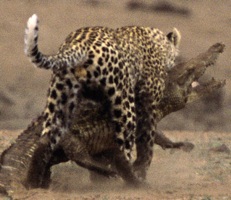
Leopard Vs. Crocodile
The Clash of the Titans
I shot this sequence of photos in Kruger National Park, South Africa.
It is the only time this behavior has ever been photographed. Ever.
People have witnessed crocodiles killing leopards but rarely the other way around.
This crocodile is probably about 7 feet long and therefore not even half of full size. (Nile crocodiles grow to roughly 15 feet). But still it is pretty evenly size-matched with this leopard.
For the full story about the day this happened, and what it was like to experience this once-in-history event, read my photo story The Best Day Ever.
VIDEO @
Bletchley Park kicks so much butt
Bletchley Park kicks so much butt

Yesterday, I got one of the best and most memorable birthday presents of my life -- a trip to the legendary Bletchley Park, site of the British WWII codebreaking effort, where Turing and co invented modern computer science and cryptography. The site is just as I'd imagined it -- a rotting, lovely old mansion surrounded by modest, slope-shouldered sheds with a variety of exhibits staffed by knowledgeable, friendly geeks who clearly find it all every bit as exciting as I do.

The cipher machines and radio equipment naturally form the centerpiece of the museum, and there's an entire computer history museum onsite (it was closed, with the strangest sign I've ever seen, words to the effect of, "This site is closed for maintenance. Enter at your own risk. You may be escorted off the grounds by security if you are caught here." Huh?) along with the notorious Nazi Enigma machine that was kidnapped in 2000 and ransomed back (the crime was never solved). The historic material on the Enigma (which began life as a commercial product before the war!) is really excellent, as are the technical explanations of how it worked.

But best of all are the "rebuilds" -- reconstructions from plans of the bombes (parallel decoding machines) and Colossus (the massive and gorgeous machine that was one of the earliest general-purpose computers. These hulking beasts are real artisanal pieces, with the hand-crafted, prideful look of devices built by loving and obsessive engineers who really, really care about their work.

Walking the grounds, I got a real sense of the lives of the people who'd worked at Bletchley, through a series of exhibitions that included quotations from oral histories about the dress, romance, food, family life and internecine conflict that characterized Bletchley Park during the war years. The exhibit on clothing was especially memorable, if only because it could bring home the gold for Britain in the 2012 Scariest Mannequin event, as was the astoundingly cool room devoted to the wartime use of messenger pigeons, including replicas of the awards given to especially brave and dedicated birds.


The Trust that runs Bletchley Park has done a really fine job, and is clearly thinking creatively about the best way to continue to fund their operations. The mansion's slate roof is in need of a multi-million-pound replacement, and they're selling "genuine fragments" of the existing slate -- holy relics of crypto's formative years, as well as soliciting donations and selling memberships. But most intriguing was the idea of renting out part or all of the site for parties and weddings -- maybe for my 40th birthday in three years...
Link, Link to my photos

Pocket Enigma Machine in a CD jewel case
Pocket Enigma Machine in a CD jewel case
Bletchley Park, the "home of the codebreakers" -- where Alan Turing and co cracked the Nazi Enigma machine -- sells "Pocket Enigma Machines" made from a clever cardboard disc inserted into a CD jewel case. It comes with a very good booklet explaining the basics of ciphering and deciphering with Enigma, and with a bunch of fun Enigma-related activities. Proceeds go to the nonprofit that runs the excellent Bletchley Park museum.
Link
The instructions supplied explain how Pocket Enigma works and take the user step-by-step through the process of coding and decoding. Worked examples and carefully annotated figures illustrate how the Key and Message Setting are used, and there is a trouble-shooting table to help with common errors. For young readers there is also a simplified way of using it called Junior Pocket Enigma making it suitable for all ages who can read and write their own messages.

Computer mouse heading for extinction
 Computer mouse heading for extinction

Jul 21, 2008
|
Are the Wii MotionPlus and iPhone examples of how we'll be using PCs in years to come? Experts say the humble input device is being usurped by touch screens and facial recognition.
The computer mouse is set to die out in the next five years and will be usurped by touch screens and facial recognition, analysts believe.
Gartner said that innovations from electronics firms creating new interactive interfaces for gaming and smartphones are driving the demise of the mouse.
Steven Prentice, vice president and Gartner Fellow, told the BBC that devices such as Nintendo's MotionPlus for the Wii and Apple's iPhone point the way to the future, offering greater accuracy in motion detection.
"With the Wii you point and shake and it vibrates back at you so you have a two-way relationship," said the analyst.
"The new generation of smartphones like the iPhone all now have tilting mechanisms or you can shake the device to do one or more things."
Prentice also highlighted home entertainment efforts from Panasonic which employ hand and facial recognition techniques to display information in place of a conventional remote control.
However, while the mouse's 40 year-old reign is coming to an end, the keyboard is here to stay, according to the analyst.
"For all its faults, the keyboard will remain the primary text input device. Nothing is easily going to replace it," he said. "But the idea of a keyboard with a mouse as a control interface is breaking down."
"For all its faults, the keyboard will remain the primary text input device. Nothing is easily going to replace it," he said. "But the idea of a keyboard with a mouse as a control interface is breaking down."
Heart surgery for 100-year-olds

JAMES ESTRIN/NEW YORK TIMES
Hazel Homer, 104, poses in her East Rockaway, N.Y. garden. She was given a specialized pacemaker and defibrillator a month before her 100th birthday.
Heart surgery for 100-year-olds
Not all doctors approve of increasingly common aggressive treatments for 'late-elderly' patients
July 20, 2008NEW YORK TIMES
When Hazel Homer was 99, more than one doctor advised that there was little to be done about her failing heart except wait for it to fail a final time. But Homer was not interested in waiting to die.
Now, at 104, her heart is still ticking, thanks to a specialized pacemaker and defibrillator that synchronizes her heartbeat and can administer a slight shock to revive her if her heart falters.
Her operation, a month shy of her 100th birthday, reflects what some doctors are hailing as a new frontier in medicine: successful surgery for centenarians. But others say such aggressive treatment for what are euphemistically known as the "late elderly" can be wasteful and barbaric, warning that the rush to test the limits of technology can give patients false hope and compound their health challenges with surgical complications.
"She's just a peek into the future," said Dr. Steven Greenberg, a Long Island, N.Y., cardiologist who performed Homer's surgery, for which the average Medicare reimbursement at the time was $35,000.
It's hard to track, since people over 75 are scarcely represented in clinical trials, but several geriatricians said procedures that two decades ago were seldom considered for people in their 90s are now increasingly commonplace. They include hip and knee replacement, cataract surgery, heart valve replacement, bypass operations, pacemaker implantation and treatment for slow-growing cancers that afflict areas like the prostate.
The Census Bureau says there were 90,422 centenarians in America in June, up from 50,454 in 2000. Demographers project there could be 1.1 million by 2050.
With such rapid growth of centenarians, debate has mounted over how far to go in providing major medical services to extend already very long lives.
Dr. David Goodman, a co-author of the Dartmouth Atlas of Health Care, said there is much research suggesting most aggressive treatment of late-stage chronic diseases doesn't actually prolong life and can actually decrease its quality.
Of Homer, Goodman said: "The odds are that she's really an amazing exception. The question is not a relatively healthy, smart, sensible 99-year-old getting a life-prolonging procedure, one that prolongs the quality of life. The question becomes the 82-year-old with dementia who has cancer or congestive heart failure."
Greenberg, a cardiologist at St. Francis Hospital in Roslyn, N.Y., said Homer is his oldest patient, and one of a handful of people nationwide her age who have received this type of heart device. But he has implanted about two dozen devices like hers in patients 90 or older over the past five years and he counts among his patients a 93-year-old "with a full head of hair" who got a defibrillator in his 80s and is still practising law.
Then there's Dr. Michael DeBakey, the pioneering heart surgeon who died July 11 at age 99. Two years ago, DeBakey underwent an aortic-dissection repair procedure that he himself had long before devised – but only after doctors convened an ethics committee to decide whether it was appropriate.
Homer did not receive a regular pacemaker but rather a biventricular defibrillator, which synchronizes her heartbeat and can automatically shock her to save her from a fatal arrhythmia. In 2007, about 55,000 people received such combination devices according to Greenberg, a consultant to the three main manufacturers of the device, who estimated that people 90 or older accounted for fewer than 100 of the devices.
Dr. Karen Alexander, an associate professor of cardiology at Duke University, said the defibrillator might go too far. "Many people say that would be a nice way to go when you're 100: to be sleeping and have your heart stop. The defibrillator component would very possibly prevent that."
Greenberg admits he "wouldn't have wanted to advertise" the operation on Homer when it was unclear how long she would survive. Now, he argues that the operation cost less than repeated hospitalizations for heart failure.
"People pay more for their BMW, which will not save their life," he said.Lawn Chair Balloonist Makes It to Idaho

Lawn Chair Balloonist Makes It to Idaho
By KEITH RIDLER
AP
CAMBRIDGE, Idaho (July 6) - Using his trusty BB gun to help him return to Earth, a 48-year-old gas station owner flew a lawn chair rigged with helium-filled balloons more than 200 miles across the Oregon desert Saturday, landing in a field in Idaho.
Kent Couch created a sensation in this tiny farming community, where he touched down safely in a pasture after lifting off from Bend, Ore., and was soon greeted by dozens of people who gave him drinks of water, local plumber Mark Hetz said.
"My wife works at the City Market," Hetz said. "She called and said, 'The balloon guy in the lawn chair just flew by the market, and if you look out the door you can see him.
"We go outside to look, and lo and behold, there he is. He's flying by probably 100 to 200 feet off the ground.
"He takes his BB gun and shoots some balloons to lower himself to the ground. When he hit the ground he released all the little tiny balloons. People were racing down the road with cameras. They were all talking and laughing."
Couch covered about 235 miles in about nine hours after lifting off at dawn from his gas station riding in a green lawn chair rigged with an array of more than 150 giant party balloons.
Sandi Barton, 58, who has lived her whole life in this town of about 300, said she and her brother-in-law were the first ones to reach Couch and shook his hand.
"Not much happens in Cambridge," she said, adding that about half the town turned out.
"He came right over our pea field," she said. "He was coming down pretty fast."
She said Couch gave some of his balloons to local children.
It was not clear where Couch went after he landed.
It began after Couch, clutching a big mug of coffee, kissed his wife and kids goodbye, then patted their shivering Chihuahua, Isabella, on the head.
After spilling off some cherry-flavored Kool-Aid that served as ballast, Couch got a push from the ground crew so he could clear light poles and soared over a coffee cart and across U.S. Highway 20 into a bright blue sky.
"If I had the time and money and people, I'd do this every weekend," Couch said before getting into the chair. "Things just look different from up there. You've moving so slowly. The best thing is the peace, the serenity.
"Originally, I wanted to do it because of boyhood dreams. I don't know about girls, but I think most guys look up in the sky and wish they could ride on a cloud."
Couch's wife, Susan, called him crazy: "It's never been a dull moment since I married him."
This was Couch's third balloon flight. He realized it would be possible after watching a TV show about the 1982 lawn chair flight over Los Angeles of truck driver Larry Walters, who gained folk hero fame but was fined $1,500 for violating air traffic rules.
In 2006, Couch had to parachute out after popping too many balloons. And last year he flew 193 miles to the sagebrush of northeastern Oregon, short of his goal.
"I'm not stopping till I get out of state," he said.
To that end, he ordered more balloons. Dozens of volunteers wearing fluorescent green T-shirts that said "Dream Big" filled latex balloons 5 feet in diameter, attached them to strings and tied clusters of six balloons each to a tiny carabiner clip.
Each balloon gives four pounds of lift. The chair was about 400 pounds, and Couch and his parachute 200 more.
"I'd go to 30,000 feet if I didn't shoot a balloon down periodically," Couch said.
For that job, he carried a Red Ryder BB gun and a blow gun equipped with steel darts. He also had a pole with a hook for pulling in balloons, a parachute in case anything went wrong, a handheld Global Positioning System device with altimeter, a satellite phone, and two GPS tracking devices. One was one for him, the other for the chair, which got away in the wind as he landed last year.
For food he carried some boiled eggs, jerky and chocolate.
Couch flew hang gliders and skydived before taking up lawn-chair flights. He estimated the rig cost about $6,000, mostly for helium. Costs were defrayed by corporate sponsors.
Associated Press writer Jeff Barnard contributed to this story from Bend, Ore.
Subscribe to:
Posts (Atom)

 Posts


