Life seen through scratched spectacles . What is it that I believe I see in front of me, is it real or just my reality. Strange stuff at times, a world out of focus or a mind of focus.
I have heard stories about local police departments using empty parked cruisers to scare drivers into obeying the speed limit, but this is the first I have heard of an Army base pulling the same trick.
Locals in TaoYuan Province, Taiwan, noticed that the guards around a local Army base always seemed to stand in the same position without moving.
Curious, some locals went in closer to inspect the soldiers and were shocked at what they found.
The soldiers were actually dummies dressed up as soldiers and armed with fake rifles.
As the news spread, many locals began visiting the Army base to see the fake soldiers.
An official from the base explained that the reason they assigned fake soldiers to posts was due to a manpower shortage. They figured the fake soldiers would be sufficient in scaring away any attackers.
The Army base has now removed the dummy soldiers after being harshly criticized for the “ridiculous act”.
Classified by BirdLife as Vulnerable, Indian Skimmer is dependent on India's wetlands. Photo: Otto Pfister
July 25, 2008 - A new and monumental book details more than 100 Indian wetlands that campaigners believe desperately need protection from pollution, development and other forms of misuse.
The 560-page tome describes 160 coastal and freshwater sites only 25 of which have been classified under the international Ramsar wetland treaty. The areas range from the Deepor Beel bird sanctuary in Assam to the Tisgul Tso marshes of Lakakh in the Himalayas and Suchindram and Theroor wetlands at the southern most tip of India.
The authors, Zafar ul Islam and Dr Asad Rahmani of the Bombay Natural History Society (BNHS, BirdLife in India) call these wetlands India's "liquid treasures." They add in the book's preface: "The 25 Ramsar sites in India do not represent even a fraction of the diversity of wetland habitats existing in the country.
"In a country like India, where nearly 80 per cent of the population depends on agriculture, rainwater, wetlands, rivers, wells and canals are important to sustain agricultural activities.
"Wetlands are also important for biodiversity conservation because some of the most endangered species survive on wetlands."
The BNHS will present the book, Potential and Existing Ramsar sites in India, to India's Vice President, Mohammad Hamid Ansari, at a special event in New Delhi today (July 25).
The organisation, the oldest conservation group in India, together with the RSPB (BirdLife in the UK), is urging the Indian government to give many more of its wetlands Ramsar status at the next Ramsar convention in South Korea in October.
Many of the 135 sites not listed by Ramsar but included in the book do have some protection under Indian law and only last week, the Chhari-Dhand wetland in Gujarat was made a Conservation Reserve by the state government, after 20 years of lobbying.
These 1,500-square mile grasslands host 270 bird species including 32 different birds of prey and 40,000 common cranes in winter. Desert cats, desert foxes and wolves are found at the site too.
Dr Rahmani, the BNHS Director, said: "Wetlands play a major role in the ecological security of our country. With the looming threat of climate change and food scarcity, we must protect our existing wetlands and revive degraded ones so they can play their ecological role."
Ian Barber, an Asia specialist at the RSPB, said: "The new sites described in the book all meet the criteria necessary for Ramsar status. The book deliberately covers every Indian state because each one boasts some hugely important sites.
"The book is a major step forward in detailing India's environmental riches. India is one of the world's top ten countries for diversity of wildlife and we hope the Indian government will do all it can to recognise this and protect the ecological that wealth few other nations have."
Ashley Glass, 18, and Joshua Schacht, 22, arrive at their wedding ceremony on Dondi the elephant at the Southwick Zoo in Mendon Saturday. Joshua's family runs the elephant education program at the zoo and Dondi has been part of the Schacht family for 32 years. At left is Phillip Schacht, father of the groom. Both bride and groom are working this summer at the zoo.
By Tanya Girgenrath, Daily News correspondent
GHS
Posted Jul 26, 2008 @ 11:47 PM
Last update Jul 26, 2008 @ 11:49 PM
MENDON —
It's not uncommon for a groom to include his sister in his wedding party. The story becomes significantly more unique when you find out his "sister" is an elephant.
Joshua Schacht, 22, and Ashley Glass, 18, were married last night at Mendon's Southwick Zoo in a wildly entertaining ceremony. Dondi, a female Asian elephant, served as the flower girl in the couple's wedding, but that wasn't her only job.
The ceremony began, amidst whispers of amazement from the crowd, when the couple mounted the elephant and circled around the altar. Dondi, true to her title of flower girl, was carrying a basket of flowers with her trunk.
Guided by Phil Schacht, the groom's father and officiator, the elephant escorted the couple to the altar, where they slowly dismounted.
"She was sitting my arms, and there's no way I would let get go," Joshua Schacht said.
Flowers decorated the area that is usually used for Dondi's show at the zoo. Dondi herself was covered in intricate floral arrangements done by Lucille's Floral Designs in Uxbridge
"It was a very unique request, and we were so pleased to do it. We did whatever we had to do to make it work for them," said Lucille Aldrich, owner of the shop.
But the couple wanted only the best for Dondi, since she's not just any elephant - she's part of the family.
The elephant is owned by Schacht's parents, Phil and Fran Schacht, who bought Dondi in 1974, 12 years before their son was even born.
"My wife and I ran away and joined the circus in 1966," Phil Schacht said. "By 1974, we were too old to do the aerial act, but we wanted to stay in show business. That's when Dondi entered our lives. She was 1-year-old and 600 pounds."
Despite the species barrier, there was still some sibling rivalry between Joshua Schacht and his "8,000-pound big sister."
"When Joshua was born there was definitely some jealousy coming from Dondi's side, but ultimately he was riding her before he learned to walk," Phil Schacht said.
Although the Schacht family is from Florida, they are here for the season performing a show with Dondi at Southwick Zoo called "Dondi and Family." And the family just got bigger.
Working with an elephant may be new territory for Glass, who is joining the Schacht family act, but she is no stranger to animals. The bride grew up on a farm and has been involved in horse shows.
"I'm so excited, I love being around the family and the elephant. It's a blessing to me, and I can't wait," said the bride moments before the ceremony began.
We Have A Drinking Problem, And It Makes Oil Seem Cheap It is an astonishing kind of stupidity that sees us duped into paying for bottles of water - stuff that flows free out of taps
by Marina Hyde
A half-litre bottle of water in your average sandwich chain, now costs 80p. That’s around four times the price of oil. And it’s not like you’ve got an oil tap in your own kitchen. If only there were some godforsaken country we could invade in the adorably misguided belief that it would bring the price of this stuff down.
And yet - perhaps because bottling water is precisely the sort of business that would entrance Dick Cheney - we’ve yet to alight on the killing fields that would get us out of this mess. Not that bottled water giants such as Nestlé and Coca-Cola would class it as a mess, what with the global industry being worth £30bn and rising. For the rest of us, I’m afraid it’s time to swallow the bottled water lecture again. Come on: more of it is being sold than beer - you and I know that can’t be right.
In her book Bottlemania: How Water Went on Sale and Why We Bought It, the investigative writer Elizabeth Royte covers it all: the nonsense about mineral water’s “health benefits”; the struggles of the communities from where this stuff is pumped in its billions of gallons; the huge environmental damage; the debunked science behind the eight glasses a day recommendation; the incredibly rare health scares related to municipal water supplies that are hyped by persons unknown (who could they be?) and drive people to purchase yet more of this stuff - supplies of which are dwindling. She fears water wars. She wonders how unworkably inconvenient it is for people to refill a reusable bottle.
So given that tap water regularly wins in blind tastings, you have to marvel at the marketing genius that continues to sell it to us in ever more mind-boggling quantities. Consider bottled water’s hold on women in the 18-35 age bracket, to whom it is most ruthlessly marketed. One of the more pathetic sights available to modern urbanites is that of some office worker lugging round her bottle of Evian in the manner of a supermodel. Was there not tap water where she set out from? Is there not tap water where she is going? She does not look like Gisele. She looks like Linus from Peanuts with his security blanket.
You know who needs drinks carried round at all times because they may require one in transit? Babies. Mewling, puking, lovably helpless - and in blissful ignorance about the concept of self-discipline. In short, they have no control over what happens at either end of their alimentary canal. Perhaps the marketing men could reposition adult nappies, so that the same misguided urbanites could cosset themselves in one of those, in case they need to “go” while walking between appointments.
Guaranteed to make you more angry than the infantilised urbanities, though, is Michael Mascha, author of Fine Waters: A Connoisseur’s Guide to the World’s Most Distinctive Bottled Waters (Emperor’s New Clothes Press; price: your dignity). This book is so pretentious I initially assumed it had been written as a dare. Mascha lectures you about the “terroir” of different bottled waters, about their “mouthfeel”, about their distinctive molecular structures. He sees sophistication as changing waters with each course and frets about the sorry state of stemware culture.
“Beyond the flavour considerations,” he instructs his late-capitalist disciples, “you should also take intangible considerations like presentation and a water’s story into account when choosing your bottled water. I look forward to the time,” he continues, “when people can select not only the vodka for their martini, but also the ice.”
I look forward to the time when those people are wiped out by a highly targeted plague. Arguably the most loathsome water he plugs is called Bling. I think it is described as a “couture water” - I can’t be sure, the book went out of the window at that point - but the bottle is studded with Swarovski crystals and costs £20 for 750ml. Bling is one of those products the mere purchase of which should result in your voting rights being withdrawn in perpetuity. You have just spent £20 on a bottle of water: you no longer have the right to participate in decisions that may affect society’s direction.
If you bang on endlessly that bottled water tastes better and that even filtered isn’t as nice, you should take a good hard look at Mascha and his preposterous book, because if things carry on at the rate Royte is chronicling, he is the Spirit of Your Future.
It seems increasingly rich that those who laugh at Madonna for drinking her Kabbalah water, blessed by the faux-religion’s rabbi, will cheerily fork out for another brand, blessed by some Big Water executive fibbing it’s healthier than tap water. Similarly, those who bang on at dinner parties about Nestlé pushing powdered milk in the third world should stop serving Nestlé’s brands of bottled water at said dinners. Poor benighted Africans, paying for something they could get for free in the misguided belief it’s better for them …
If this analogy is not sufficiently sledgehammer, they may care to consider that in the 1950s Nestlé pushed its bottled waters “to help lactating mothers and [provide] important minerals for infants”. It has since modified its sell, producing in 2002 a catering trade manual called Pour on the Tips, in which waiters were advised they could make $100 more a month using a few simple water-pushing techniques.
This is what a conspiracy theory that actually stands up looks like. The entity we are obliged to call The Man really is fooling you. I’m sorry it’s not blowing up the World Trade Centre, or lying about the Titanic sinking. But it’s low level mostly because duping you doesn’t need anything fancier. He can make you pay between 240 and 10,000 times more for something you already have on tap. Crack open a bottle of Bling and drown your sorrows: Lex Luthor doesn’t even get out of bed for schmucks like you.
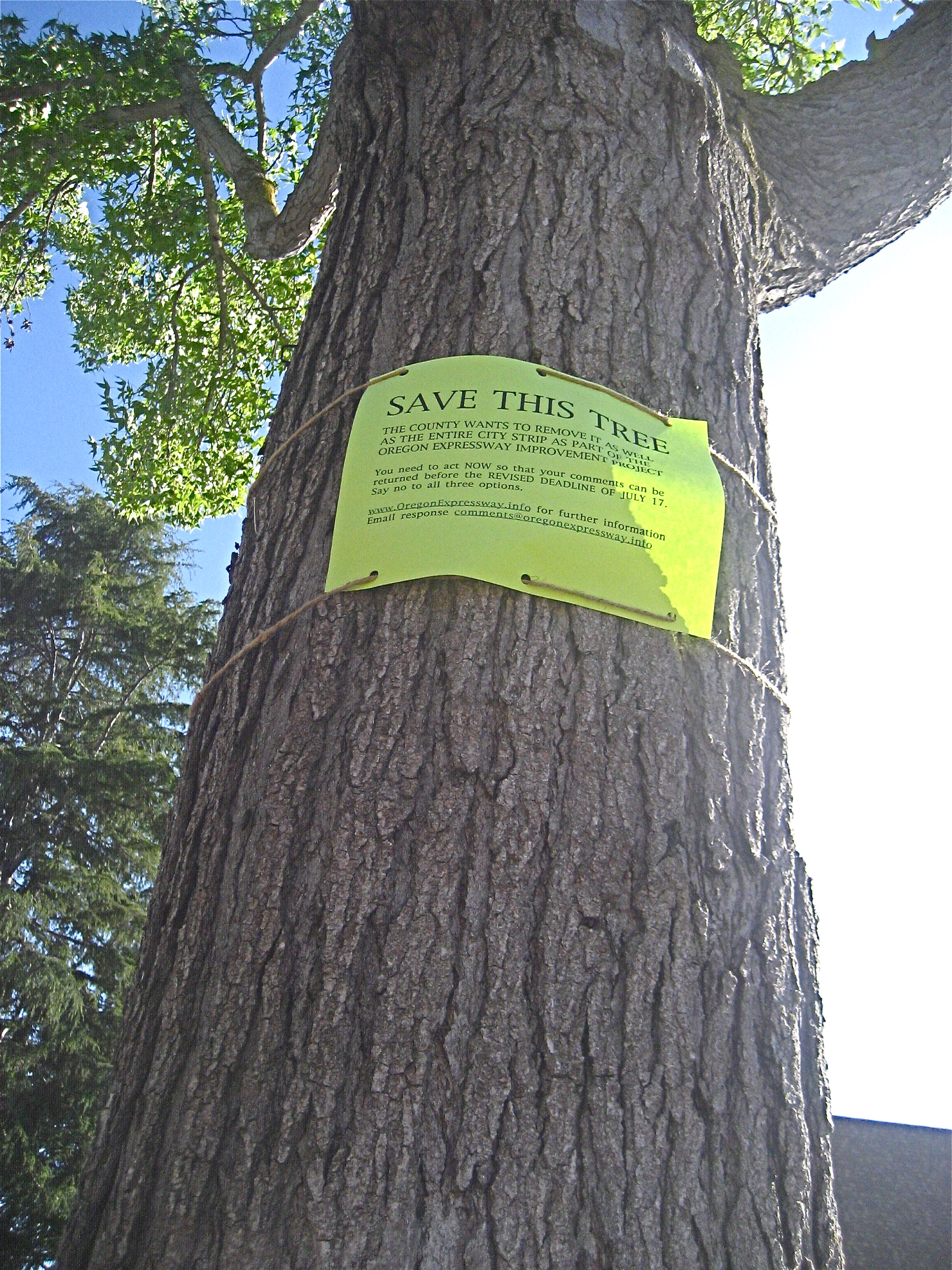
Save our Trees! Protect Our Green Space! Preserve Plans for Bike Boulevards!
Palo Alto residents and San Francisco Peninsula bike commuters are challenging Santa Clara County's plan to widen Middlefield Rd. near Oregon Expressway.
Proposed alterations to Middlefield Rd. near Oregon Expressway call for removing the trees and resident-created green strip gardens between the sidewalk and traffic lanes. This will eliminate the buffer between cars and pedestrians now enjoyed by neighborhood walkers and students commuting to Jordan Middle School.
Santa Clara County conducted what some residents are calling a stealth campaign. County officials placed confusing announcements in the local paper and sent mailings describing the changes as "improvements to Oregon Expressway", a county road. In fact, the county's plan is to widen Middlefield Rd. (near Oregon Expressway). Other county-proposed alterations in the neighborhood will affect Palo Alto's commitment to improved bike paths.
Bicycle enthusiasts object that putting in a raised median to block Ross Rd. (part of the county's proposal) runs counter to plans for a bike boulevard there. Some Palo Alto city officials say the bikeway will become impossible if that median is built as planned.
The plan to spend $2.8 million in federal funds to "streamline traffic flow on Oregon Expressway in Palo Alto" is generating significant opposition. Concerned residents say that County officials announced community meetings during peak vacation times and without adequate notice.
A public hearing is scheduled for September 2008. Send comments to the county or get on the mailing list to receive notice of specifics of the upcoming public hearing.
Contact the county by mail, email or phone (contact info below).
Please provide your input to the City of Palo Alto Planning Office as well as to the county. Because Middlefield is a city street, the project can only go forward with the city's approval.
Going through airport security checkpoints can be a pain, especially for folks who carry notebooks with them. Some airports require you to take out the notebook from the notebook case/bag, boot it up (good thing they don’t do a check on the authenticity of the software within as that would probably cause plenty of folks from Third World countries to end up in the slammer), and shut it down. Aerovation aims to cut all that hassle with a new Checkpoint Friendly Laptop Bag. This patent-pending product was recently tested by the Transit Security Administration (TSA), and has been given the nod of approval, making travel much less of a hassle for everyone (passengers and airport staff alike).
Developed in response to TSA’s industry-wide call for easy-to-screen laptop bags, the Checkpoint Friendly Laptop Bag is the latest solution by Aerovation Products, a company dedicated to creating smart accessories for the travel and aviation industries. Officially debuting to consumers worldwide, the Checkpoint Friendly Laptop Bag is designed to allow travelers to keep their laptops safely in. The Checkpoint Friendly Laptop Bag functions by holding the laptop in a compartment separate from accessories and other items. It easily peels open for placement on the X-ray screening belt. Once that’s done, the bag quickly folds shut. Differing from other designs, the Checkpoint Friendly Laptop Bag uses a patent-pending, top-hinge method of opening and closing. This returns the bag to its carrying configuration simply by picking it up from the belt. There are no snaps, buckles or zippers to reconnect the compartments. The compartments cling to each other automatically.
Frequent travelers will definitely be interested in the Checkpoint Friendly Laptop Bag, and it will come in 15.4″ and 17″ sizes - big enough to store plenty of Eee PCs and other similar netbooks with room to spare. No idea on how much they will cost, but you can choose from either leather or faux-leather styles.
My Red Hot WordPress Blog Also called:Nuclear and Indigenous Items of Interest
This WordPress Bog also dedicated to Corbin Harney, it has over 34,000+ hit so far and has been mentioned in the WordPress blog also. It is at http://gregornot.wordpress.com/ Come check it out as it will be part of the new Shundahai.org Web site.which is currently undergoing renovations. Please visit both sites.
I’m a Indigenous Rights, Social Justice and Anti-Nuclear Activist. I believe we need to break the Nuclear Cycle to save this Planet. I worked for 20+ years at the Nevada Test Site, doing non-violent direct actions. I was the very first person arrested at Yucca Mountain. I was arrested uncountable (hundreds) times at the Nevada Test Site (NTS). I am also writing a book “The Shundahai Network: A Decade of Resistance”. In addition, I am making a DVD/CD of Corbin’s Harney(Western Shoshone Spiritual Leader, who has passed over)last Public Sunrise Ceremonies & Songs(with his verbal permission as seen on DVD). If you wish to contribute materials, Audio, visual or memories of Shundahai Network (SN), contact me : gregornot AT gmail.com and I will send my snail mail address for mailing photos or audio or video materials.
Shundahai Friends,
Those of you who wish to send Audio. Video, Photos,Stories or uplifting memories of Corbin Harney (including who,what, where) for part of the book honoring Corbin and the Shundahai Network,”The Shundahai Network: A Decade of Resistance” may mail them to Gregor Gable (Web Master of Shundahai Network Domain and a personal friend of 20 + years) :
All materials will be returned and proper credit will be given in the book. Please print clearly your snail mail address, so that I may return materials, along with a note given me permission to use the materials in this book. This is a Book Corbin Harney authorized me to write, and I have been working on it for quite a while.
This is a record of Corbin’s non-stop fight against radioactivity and his attempts to have the traditional lands returned to the Newe people(after it had been cleaned up) under the Treaty of Ruby Valley 1863 and the people who helped him know as The Shundahai Network.
Why Leave Comments- We can all Win through OPEN discussion
Please leave comments, so we can discussion solutions to common problems, as Corbin says “Only, We the people can solve these problems” Please leave an email so we can discuss issues & your blog URL, please.
Nuclear Issues of Interest Blog Dedicated to Corbin Harney, who passed over July 10th, 2007. Corbin's last words. "We are one people. We cannot separate ourselves now.There are many good things to be done for our people and for the world. It is important to let things be good and it is important to teach the younger generation, so that things are not lost."
Also see my Vipassana blog
Also see my Vipassana blog at:http://gregors-vipassana-voyage.blogspot.com/ What I discover on my Journey through Vipassana mediation & how I managed to get to India and the KUMBH MELA TOUR ( in January of 2007) with 200 million people in attendance,my PTSD and my crowd avoidance issues.
Varanast, (Benares), one 0f the oldest cities in the world and the holiest of all Hindu cities. Its narrow streets are lined with hundreds of temples honoring Hindu deities, and hundreds of pilgrims crowd the ghat stairways leading to the Holy River Ganges.
The changes it makes of my life's perspective of reality, as it exists in my head of my life's journey, with emphasis on daily life in India . Spiritual mediation, some nuclear weapons issues and some humor in content.



 Posts
Posts


