Tuesday, July 22, 2008

Loss of Wolves Causes Major Ecosystem Disruption at Olympic National Park

Loss of Wolves Causes Major Ecosystem Disruption at Olympic National Park

By: Oregon State University

elk.jpg
Elk grazing in Olympic National Park
CORVALLIS, Ore. July 11, 2008 - Olympic National Park was created in 1938, in part "to preserve the finest sample of primeval forests in the entire United States" - but a new study at Oregon State University suggests that this preservation goal has failed, as a result of the elimination of wolves and subsequent domination of the temperate rainforests by herds of browsing elk.

The park, with streamside ecosystems that have been largely denuded of the young trees needed to replace the old ones, and stream systems that bear little resemblance to the narrower and vegetation-lined rivers of the past, is now anything but "primeval" and a very different place than it was 70 years ago, researchers say.

The extermination of wolves in the early 1900s set off a "trophic cascade" of changes that appear to have affected forest vegetation and stream dynamics, with possible impacts on everything from fisheries to birds and insects, the scientists wrote in their report, just published in the journal Ecohydrology.

Members of the Press Expedition, hiking in 1890 through what is now Olympic National Park, found the banks of the upper Quinault River "so dense with underbrush as to be almost impenetrable," they wrote at the time. Logs jammed the rivers, dense tree canopies shaded and cooled the streams, and trout and salmon thrived along with hundreds of species of plants and animals.

"Today, you go through the same area and instead of dense vegetation that you have to fight through, it's a park-like stand of predominantly big trees," said Bill Ripple, a co-author of the study and forestry professor at Oregon State University. "It's just a different world."

That world may still be quite beautiful with its jagged, glacier-covered peaks and towering old-growth trees. But it's not the same one that so impressed President Theodore Roosevelt in 1909 that he created Mount Olympus National Monument - in large part to help protect elk herds that had been decimated by hunting. The Roosevelt elk, a massive animal that now bears his name, can weigh more than 1,000 pounds.

With protection from hunters and extermination of wolves not long after that, elk populations surged, and OSU researchers say that in the intervening decades the very nature of Olympic National Park has changed dramatically.

"Our study shows that there has been almost no recruitment of new cottonwood and bigleaf maple trees since the wolves disappeared, and also likely impacts on streamside shrubs, which are very important for river stability," said Robert Beschta, lead author of the study and professor emeritus of forest hydrology at OSU. "Decreases in woody plant communities allow river banks to rapidly erode and river channels to widen."

"Tree and shrub species along stream banks and floodplains started crashing first," Beschta said. "Then, apparently, the rivers began to unravel. Now we have large areas where the forest understory vegetation is mostly just grasses and ferns."

The study showed that river dynamics are quite different than they were historically. Streams that once were held together in tight channels by heavy bank vegetation are now wider and braided, with exposed gravel bars a common feature. The water is open to the warming sun and less enriched by plants and insects. Nearly half of the terraces along the Queets River have disappeared because of accelerated erosion over a period of multiple decades.

"We've seen the impact of wolves on the ecosystem in Yellowstone, the effect of cougars in Yosemite National Park, the same basic story about the importance of key predators being played out in many different places," Ripple said. "What's so surprising here is that it's happening in a temperate rainforest, which is hugely productive and has such high levels of vegetation growth. But even there, when the ecosystem gets overwhelmed with many large herbivores, the vegetation just can't keep up."

In an area outside Olympic National Park where little foraging by elk occurred, tree recruitment has been normal and healthy in recent decades.

Since the Olympic National Park ecosystem bears some similarity to much of the temperate rainforests in the Coast Range of Oregon, Washington and British Columbia - with a mild climate and heavy levels of rainfall - it's reasonable to believe similar forces are at work elsewhere when historic predators have been removed, the scientists said.

"Unlike some of the studies we've done in the Rocky Mountains, arid desert or canyon ecosystems, for us this one is hitting a little closer to home," said Beschta, a forest hydrologist who has studied Pacific Northwest streams for more than 30 years. "These processes are at work right in our backyard."

In multiple studies in the U.S. and Canada, usually in national parks where supposedly "pristine" ecosystems are still available, the OSU scientists in recent years have documented the critical impacts on ecosystems when key predators disappear - usually wolves or cougars. It has been shown that such predators help control the grazing impacts of elk and deer on several levels, by keeping their population levels down, but also in changing their patterns of behavior - a process that has been called "the ecology of fear."

In the most classic case where these predators have been brought back into the ecosystem - wolves in Yellowstone National Park - OSU scientists have found that some stream ecosystems are now starting to recover where they had been in serious decline for more than half a century. Streamside trees and shrubs, beaver dams, and native plants, animals and fisheries are being restored.

An effort was considered to restore wolves to the Olympic National Park ecosystem in recent years, but no decision or actions have been undertaken to accomplish that, the OSU scientists said.

Report: http://www3.interscience.wiley.com/journal/120750202/abstract

Nutty News Humor: Texans causing trouble


Gabriel went to the Lord and said, 'I have to talk to you. We have some Texans up here who are causing problems...
They're swinging on the Pearly Gates, my horn is missing, and they are wearing T-shirts instead of their robes; there's barbecue sauce and picante sauce all over everything, especially their T-shirts; their dogs are riding in the chariots and chasing the sheep; they are wearing baseball caps and cowboy hats instead of their halos. They refuse to keep the stairway to Heaven clean, and their boots are marking and scuffing up the halls of Wisdom.
There are watermelon seeds and tortilla chip crumbs all over the place. Some of them are walking around with just one wing; and they insist on bringing their horses with them.'
The Lord said, 'Texans are Texans, Gabriel. Heaven is home to all of my children. If you want to know about real problems, call the Devil.'
So Gabriel calls the Devil who answers the phone and says, 'Hello---hold on a minute.' When he returns to the phone the Devil says, 'O.K., I'm back. What can I do for you? '
Gabriel replied, 'I just want to know what kinds of problems you are having down there with the Texans.'
The Devil said, 'Hold on again. I need to check on something.' After about 5 minutes the Devil returned to the phone and said. 'I'm back. Now what was the question?'
Gabriel said, 'What kind of problems are you having down there with the Texans?'
The Devil said, 'Man, I don't believe this...hold on.' This time the Devil was gone 15 minutes and when he returned he said, 'I'm sorry Gabriel, I can't talk right now. Red Adair has put out the fire and Brown and Root is installing air conditioning.' Submitted by a Nutty News Reader

COUNCIL CALLS CHIME ON THE ICE CREAM VAN JINGLE

COUNCIL CALLS CHIME ON THE ICE CREAM VAN JINGLE

Story Image


Children enjoy ice creams from a traditional van

TRADITIONAL ice cream vans could become a thing of the past after council killjoys branded their cheery chimes as noise pollution.

Strict rules have been introduced in one city which say that vendors can now only play their distinctive jingles for a few seconds at a time.

Ice cream sellers fear the changes will hit their businesses as they struggle to compete in the face of cheap supermarket prices and a washout summer.

Worcester City Council says it introduced the guidelines to make the system fairer.

The rules state that vendors driving around the streets can only sound their chimes for four seconds at a time and must leave at least three minutes between blasts.

Sellers wanting to stay in the same street for a prolonged period have been told they can only sound their jingles every two hours.

Other rules prohibit vendors from playing chimes outside places of worship or schools during lessons, or from playing within sight of another ice cream van.

The rules were drafted by the city’s licensing committee after complaints about the way some traders were operating.

But Dean Clarke, of Dean’s Ices in Worcester, said the guidelines could sound the death knell for ice cream businesses in the city.

He said: “It’s silly and it will just speed up the death of what used to be a great British institution.

“The ice cream van coming round was something that kids used to look forward to. They won’t even have a clue now if there’s one outside.”

Tom Davidson, spokesman and former president of the Ice Cream Alliance, said: “I have never heard of anything so ridiculous.

“When I am out in the van I probably play a minute to let everyone know I am there. The idea that the chimes are causing noise pollution is just complete nonsense.”

Mr Davidson, who has been in the business for more than 40-years, fears that ice cream vans will have disappeared from the streets by 2010.

He said: “The council should just wake up. They are totally out of touch with reality. They are actually trying to spoil what is a great tradition.”

Worcester City councillor Paul Denham branded the new rules a “waste of time” and “frankly unpoliceable”. He said: “Our council is very good at bringing in new rules and regulations but are not very good at actually enforcing them.”

But Andy Fox, senior licensing officer in the city, defended the measures saying they were supposed to help ice cream vendors.

He said: “We have had a number of complaints about one particular trader within the district and because the previous conditions were ambiguous it gave him a way off the hook.

“Now we have incorporated code of practice guidelines into our licensing conditions.

“We are not out to get rid of traders. We just want them to abide by the regulations that are laid down. Hopefully, this is a way forward for everyone.”

ì
It’s silly and it will just speed up the death of what used to be a great British institution
î

Dean Clarke, of Dean’s Ices in Worcester

Shanghaied in Beijing

Shanghaied in Beijing

Indentured Teaching, French Generals and Fake Trade Representatives

The time has come to coin a new term, Beijinged; An individual being coerced into employment through means of trickery and/or false promises in Beijing.

It’s enough to immediately drive most newcomers over the edge, straight back to the airport. A flourishing practice nurtured in numerous local English-language bulletin boards such as Craigslist. Just about every non-professional having come to Beijing looking for change has gotten vastly more change than they’d bargained for, and then some.

english-beijing Shanghaied in Beijing picture

In its most common form, getting Beijinged means going straight from the airport to an English teaching job that was pre-arranged over the Internet. The eager new teachers are greeted by numerous smiles and “ni haos” at the vast modern airport, only to find themselves in a tiny moldy apartment an hour later, full of roaches to keep them company.

Even the “lucky” of such teachers may be faced with screaming hoards of Little Emperors, while the severely unlucky may be faced with classes of 100 or more stoned, half-drunken college students smoking cigarettes and spitting on the floors of their dilapidated classrooms.

One thing is certain, so let’s debunk any myths right here and now- Chinese students are no more well behaved than their Western counterparts. To the contrary.

So, after a traumatic bout of teaching that nearly ended in permanent mental illness, the new Beijinged resident may fly screaming from the country, not even able to watch the Olympics on TV without shaking.

The ones without the means to return home may unfurl political banners on Tiananmen Square in the hopes of being deported. But, a select few of the Beijinged residents will rent their own nasty little apartments and continue looking for work from the comfort of some smoke-clogged Internet café with sticky keyboards.

Then the real fun begins……

An acting job sounded nice, until you ended up in the middle of a cold forest all night long sleeping on the ground, waiting to perform 2 minutes of acting in exchange for barely 20 bucks. Then you answer an ad reading “Native English speaker needed to attend business meetings and take notes”. It seems you may have finally found something, with professional people in a nice office at a private finance company. Then your new employer asks you to go on a “business trip”.

The following week you end up over a thousand miles away, in a rural jungle village on the border of Myanmar. The instructions are to visit a massive hydroelectric construction project with your coworkers and claim that you are an international trade representative from Washington DC.

The builders of the project are applying for financing and it turns out that your company is charging them dearly to apply for it. But, your company doesn’t actually exist. The builders get suspicious and threaten to call the Chinese FBI.

Now back in Beijing and unemployed again, you’re nervous any time a stranger comes to the door of your nasty little apartment. A new opportunity arises. An American businessman is opening a new English school and needs a manager.

A nice new apartment is provided. A monkey lives in a little cage in the courtyard, but the school looks nice. Then the American demands to keep your passport, but you are going broke and this is your last chance. You agree and take the job. A series of serious incidents over the next few weeks leads you to believe that your boss may be in the mafia, but you don’t care at this point.

Then it’s all over one day when the boss accuses you of sleeping with a 17-year-old employee that he’s been known to make unsuccessful passes at. You have never touched the girl and decide it’s time to take your money and fly.

The passport is returned after lengthy coercion.

You’ve been Beijinged.

Richie Jackson: Psychedelic Skater


I believe in psychedelicism. Not just psychedelic music, but everything. A psychedelic experience is characterized as the unveiling of perceptions previously unknown -- the brain unfettered from its usual constraints. To me, it's all there is, and certainly all that's worth doing. I find no worth in that which doesn't surprise. Anomalies, irregularities, deviation from the common rule -- that is all I will ever care for.

Monday, July 21, 2008

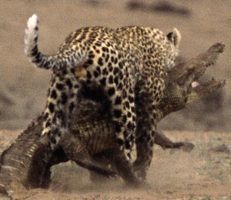
Leopard Vs. Crocodile


Leopard Vs. Crocodile
The Clash of the Titans

I shot this sequence of photos in Kruger National Park, South Africa.

It is the only time this behavior has ever been photographed. Ever.

People have witnessed crocodiles killing leopards but rarely the other way around.

This crocodile is probably about 7 feet long and therefore not even half of full size. (Nile crocodiles grow to roughly 15 feet). But still it is pretty evenly size-matched with this leopard.

For the full story about the day this happened, and what it was like to experience this once-in-history event, read my photo story The Best Day Ever.

VIDEO @

http://www.halbrindley.com/videos/pages/leopard.html

Bletchley Park kicks so much butt

Bletchley Park kicks so much butt


Yesterday, I got one of the best and most memorable birthday presents of my life -- a trip to the legendary Bletchley Park, site of the British WWII codebreaking effort, where Turing and co invented modern computer science and cryptography. The site is just as I'd imagined it -- a rotting, lovely old mansion surrounded by modest, slope-shouldered sheds with a variety of exhibits staffed by knowledgeable, friendly geeks who clearly find it all every bit as exciting as I do.

The exhibits are a nice mix of technical and historical, ranging from a truly impressive collection of memorabilia related to Winston Churchill (who visited Bletchley and congratulated the women and men there on their excellent work), including his school report-card that makes him out to be a villainous, disruptive and scattered child; to a series of exhibits of vintage wartime toys. There's a museum of ancient cinematographic equipment complete with a beautiful little theatre that shows reels of vintage newsreels and propaganda films. And of course, there are the computers and related devices.


The cipher machines and radio equipment naturally form the centerpiece of the museum, and there's an entire computer history museum onsite (it was closed, with the strangest sign I've ever seen, words to the effect of, "This site is closed for maintenance. Enter at your own risk. You may be escorted off the grounds by security if you are caught here." Huh?) along with the notorious Nazi Enigma machine that was kidnapped in 2000 and ransomed back (the crime was never solved). The historic material on the Enigma (which began life as a commercial product before the war!) is really excellent, as are the technical explanations of how it worked.


But best of all are the "rebuilds" -- reconstructions from plans of the bombes (parallel decoding machines) and Colossus (the massive and gorgeous machine that was one of the earliest general-purpose computers. These hulking beasts are real artisanal pieces, with the hand-crafted, prideful look of devices built by loving and obsessive engineers who really, really care about their work.


Walking the grounds, I got a real sense of the lives of the people who'd worked at Bletchley, through a series of exhibitions that included quotations from oral histories about the dress, romance, food, family life and internecine conflict that characterized Bletchley Park during the war years. The exhibit on clothing was especially memorable, if only because it could bring home the gold for Britain in the 2012 Scariest Mannequin event, as was the astoundingly cool room devoted to the wartime use of messenger pigeons, including replicas of the awards given to especially brave and dedicated birds.

We spent three hours on site and barely scratched the surface. We had hardly any time to look at the war-plane, didn't get to the gigantic model railroad exhibit, didn't see the whole film presentation at the Enigma theatre, and only got the most hurried of walks around the American Gardens -- and we missed the mansion tour altogether. I could have easily spent eight or more hours there, and still wanted for more. Just the tantalizing mini-lecture I got on the Colossus rebuild from one of the electronics engineers who worked on it was enough to pique my interest, and I could have spent an hour looking at the details in Turing's office.


The Trust that runs Bletchley Park has done a really fine job, and is clearly thinking creatively about the best way to continue to fund their operations. The mansion's slate roof is in need of a multi-million-pound replacement, and they're selling "genuine fragments" of the existing slate -- holy relics of crypto's formative years, as well as soliciting donations and selling memberships. But most intriguing was the idea of renting out part or all of the site for parties and weddings -- maybe for my 40th birthday in three years...
Link, Link to my photos